



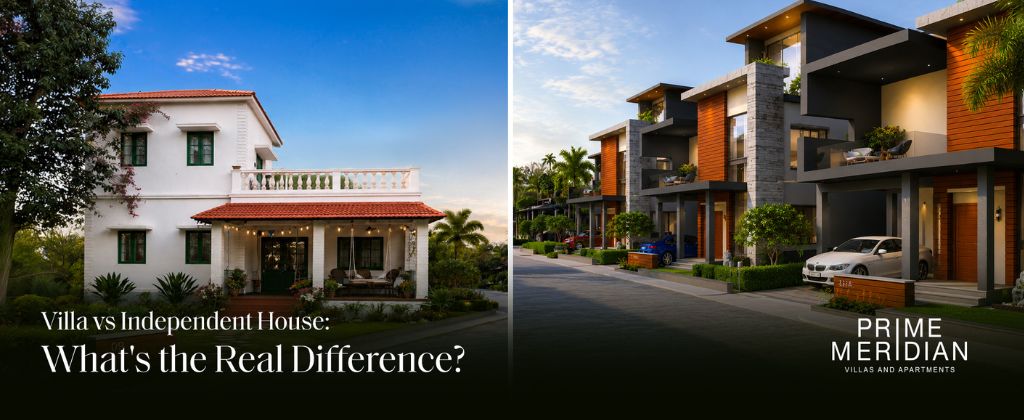
A villa and an independent house can offer much of the same appeal: more space, privacy and a home that feels distinctly your own. Yet the two are planned and lived in differently. A villa is typically part of a larger residential development, while an independent house usually occupies its own plot.
For homebuyers in India, choosing between the two involves more than comparing size or price. The villa vs independent house decision can shape how much control you have over the property, what you share with the community and what you take on as a homeowner.
What Is a Villa?
The word villa has its roots in ancient Rome, where it referred to a country residence or estate outside the city. The meaning has evolved over time, and in modern Indian real estate, a villa usually refers to a standalone home built within a planned residential development. Villas may have their own plot, entrance, parking and outdoor space, while the larger community may include shared roads, landscaping, security and other facilities.
What Is an Independent House?
An independent house is a standalone residential property built on its own plot, rather than as part of a larger housing development. The term describes the property’s physical arrangement rather than a particular architectural style. An independent house can range from a compact urban home to a large multi-storey property, with the owner generally having greater control over the building, plot and future modifications.
Key Differences Between a Villa and an Independent House
The clearest difference often comes down to where the home sits and what surrounds it. A villa is commonly part of a gated development where multiple homes share planned infrastructure and community spaces. An independent house typically occupies its own plot outside such a development, giving the owner more control over the immediate surroundings.
| Villa | Independent House |
| Usually located within a gated community | Usually located on an individual plot |
| Shares roads, landscaping and other common areas | Greater control over the space around the property |
| May have controlled entry and community security | Security arrangements are generally handled by the homeowner |
| Often follows the development’s planning and building guidelines | More freedom to plan or modify the property, subject to local rules |
| May offer shared amenities such as parks or recreational areas | Amenities depend largely on the property and its neighbourhood |
The villa vs independent house choice therefore involves more than the house itself. It also determines whether you prefer a managed community environment or greater independence over your property.
Security and Privacy
Security and privacy can differ depending on the setting of the property.
- Villas: Gated developments may provide controlled entry, security personnel, CCTV and common-area monitoring. Privacy can be influenced by the proximity of neighbouring villas and shared community spaces.
- Independent houses: The homeowner has greater control over access to the property and can choose individual security measures. Privacy may also be higher when the plot has sufficient setbacks and separation from neighbouring homes.
- Key consideration: Security features should be assessed based on the specific property rather than assumed from the property type.
Maintenance Responsibility
Maintenance is another practical difference between the two.
- Villas: Common areas, roads, landscaping and shared facilities are generally maintained through the development’s management system and associated charges.
- Independent houses: The owner is usually responsible for maintaining the house, compound, landscaping, exterior areas and other property-specific requirements.
- Trade-off: Villa owners may have less day-to-day responsibility for common infrastructure, while independent homeowners have more direct control over maintenance.
Customisation and Design Freedom
An independent house generally offers more flexibility because the property is not tied to a developer’s overall design scheme.
| Villa | Independent House |
| May have predefined floor plans or exterior guidelines | Greater freedom to choose the layout |
| Changes may require approval under community rules | Modifications are generally controlled by the owner, subject to local regulations |
| Exterior appearance may need to follow development standards | Façade and exterior design can usually be customised |
| Future structural changes may have more restrictions | Greater scope for extensions or alterations where permitted |
Price and Resale Value
There is no universal rule that a villa or independent house will always cost more or have better resale value. The comparison depends on location, land value, built-up area, construction quality, amenities, demand and the condition of the property.
- Villa: The purchase price may include the value of the home, its plot and access to shared infrastructure or amenities. Maintenance or community charges may also form part of the ongoing cost.
- Independent house: A larger portion of the property’s value may be tied to the land, particularly in established or high-demand locations.
- Resale value: Independent houses can benefit from land appreciation and redevelopment potential, while well-managed villa communities may attract buyers looking for a ready-to-use home with shared facilities.
- What matters most: Location and land value often have a significant influence on long-term property value, so resale potential should be assessed for the specific property rather than based only on whether it is a villa or independent house.
Villa vs Independent House: Which Offers Better Investment Value?
There is no straightforward winner in the villa vs independent house comparison when investment value is the priority. The better choice depends on what you are buying for, where the property is located and how the surrounding market is expected to develop.
A villa may make more sense when:
- The project is in a well-connected location with strong demand for gated-community housing.
- Buyers value security, shared amenities and a managed residential setting.
- The property is well maintained, and the development has a good reputation.
- Rental demand exists for larger homes in the area.
An independent house may be more attractive when:
- The property is located in an established or developing area with strong land demand.
- The plot has good size and potential for future redevelopment.
- The location gives the property strong access to schools, workplaces, transport and other essentials.
- Land appreciation is an important part of the investment strategy.
For either property type, look beyond the purchase price. Land value, location, construction quality, maintenance costs, rental demand and resale prospects can have a greater bearing on the investment than the label attached to the property.
Who Should Choose a Villa?
A villa can be a good fit for buyers who want the space and privacy of a standalone home without taking on every responsibility associated with an individual property.
A villa may suit you if you:
- Prefer living in a gated residential community.
- Want access to shared amenities close to home.
- Value controlled entry and organised common-area maintenance.
- Want a private home with outdoor space but prefer a managed setting.
- Are comfortable following community rules for modifications and property use.
- Plan to buy a home for family living rather than prioritising complete control over the plot.
Who Should Choose an Independent House?
An independent house may be a better fit for buyers who value control over the property and want fewer restrictions on how they use or modify their home. It can also appeal to those who see the land itself as an important part of the purchase.
An independent house may suit you if you:
- Want greater freedom to choose the home’s layout and design.
- Prefer owning and managing a property without a gated community structure.
- Want more control over renovations, extensions and future changes, subject to local regulations.
- Value a larger or strategically located plot of land.
- Prefer having your own parking, garden or outdoor areas without shared community spaces.
- Are comfortable taking responsibility for property maintenance and security.
- See long-term land value and redevelopment potential as important factors in your purchase.
Explore Our Villa Portfolio in Kochi
Prime Meridian’s villa portfolio brings together different approaches to homeownership, from gated 3, 4 and 5 BHK villas to full-floor waterfront residences. Each project offers its own combination of space, setting, amenities and privacy.
With 20+ years in Kerala real estate and 250+ villas delivered, Prime Meridian offers buyers a range of options backed by RERA-approved projects and bank-financeable homes. Explore our portfolio to find a villa that fits the way you want to live.