



Buying a flat, a house, or even just a plot of land is a huge decision for most Indians. In fact, most of us save our hard-earned money to invest in a property that we have long cherished. But alongside the emotional elements and excitement, it is equally important to understand a few key aspects from a legal perspective.
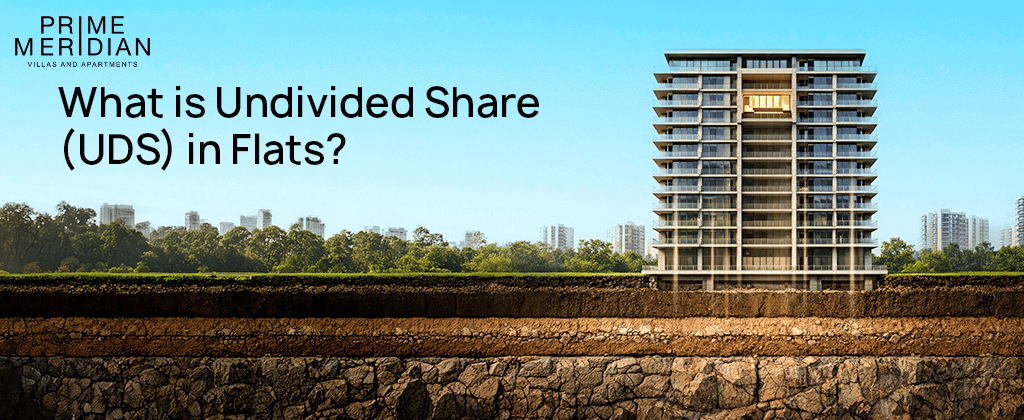
In the eyes of the law, when you buy a flat, you are buying a piece of earth on which the building stands. In connection with this piece of earth, a legal term is used. This is exactly what builders, legal experts, and real estate agents often refer to as an Undivided Share (UDS).
So, what is UDS in real estate, and how is it calculated? We will work to understand these minute concepts.
What is Undivided Share (UDS) in Flats?
In simple terms, an Undivided Share (UDS) is the portion of land held by an individual apartment owner in a residential complex. This is quite different from the standalone house you own. In that case, you completely own that specific piece of land. However, in the case of a flat in an apartment complex, all the flat owners collectively own the land.
That is exactly why we use the word – UNDIVIDED. In fact, that is the key to understanding what exactly it means. For instance, you cannot point to a corner of a garden or a particular spot in the parking lot as your own. Instead, you only own a percentage of that particular spot, just like the others. The share you have in it is equal to a proportion of the flat you own, based on the size of your flat.
Why UDS is the “Real” Asset?
Your building, or even your flat, may deteriorate or depreciate over the years. However, the land on which it stands appreciates. The building may eventually become old and be demolished for redevelopment. But the land remains the true asset.
When your building is redeveloped, the compensation or the size of the new flat you receive depends entirely on your UDS, not on the previous size of your flat.
How to Calculate UDS? (Formula with Example)
It is very easy and simple to calculate the UDS. In fact, you simply use a straightforward mathematical calculation. However, you need accurate data about the total land area and the total built-up area of the building.
The Standard UDS Formula
The UDS is typically calculated using the following formula:
UDS = (Individual Apartment’s Super Built-up Area / Total Super Built-up Area of all Apartments) x Total Land Area
Let us take an example.
Let’s look at a practical scenario to see how this works:
- Total Land Area of the Project: 10,000 square feet
- Total Number of Flats: 10
- Size of each Flat (Super Built-up Area): 1,200 square feet
- Total Built-up Area (10 x 1,200): 12,000 square feet
Calculation:
- UDS = (1,200 / 12,000) x 10,000
- UDS = 0.1 x 10,000
- UDS = 1,000 square feet
In this case, even though you live in a 1,200 sq. ft. apartment, you legally own 1,000 sq. ft. of the land.
The table below should make it more clear –
| Component | Value |
| Apartment Size | 1,200 sq. ft. |
| Total Land Area | 10,000 sq. ft. |
| Your Ownership (UDS) | 1,000 sq. ft. |
What factors affect the UDS in flats?
The definition of UDS may appear to be simple and straightforward. But the UDS does not remain similar across all apartments. In fact, even in the same apartment complex, the UDS allocation may not be equal.
Here are a few factors that may influence the UDS in flats –
The Floor Space Index (FSI)
FSI (or FAR – Floor Area Ratio) is the ratio of the total built-up area to the total plot area. If the local government allows a higher FSI, the developer can build more flats on the same piece of land.
So, what does that mean?
- Higher FSI = More flats = Lower UDS per owner.
- Lower FSI = Fewer flats = Higher UDS per owner.
Apartment size
UDS is proportional directly to the size of your flat. Imagine someone owning a 3-bedroom flat in the same apartment building as your 2-bedroom flat. The former will have a higher UDS than the latter for obvious reasons.
In other words, the higher your contribution to the total built-up area, the higher your UDS will be.
Dedicated Car Parking
In some apartment complexes, residents are given dedicated, covered parking. If you have it, it will be counted toward your total built-up area. This will slightly increase your total built-up area, and thus your UDS will be higher than that of a flat owner with no dedicated parking space.
Common areas
The total built-up area we discussed above includes common areas such as lobbies, hallways, and clubhouses. If the building has less common-space wastage, the UDS allocation can be more streamlined.
Average Land Share (UDS) in Kerala Flats
Well, the calculations and modalities in Kerala tend to differ quite a bit from the general discussion on the UDS share. Kerala is very unique and has a lot of greenery. There are also strict Kerala Municipality Building Rules (KMBR). This slightly affects the UDS in flats in Kerala.
In cities like Kochi and Calicut, the average UDS is around 30-50% of the total built-up area. In most Kerala apartments, you will see a higher UDS valuation.
Why is UDS generally higher in Kerala?
- Open Space Requirements: Kerala building laws mandate significant setbacks and open spaces for fire safety and ventilation. This means more land is left “unbuilt,” which is then distributed among fewer owners as UDS.
- Luxury Segments: Premium builders in Kerala often opt for low-density projects. In a luxury project with only 20 apartments on an acre of land, the UDS will be significantly higher than in a high-rise “pocket-friendly” project.
| Pro-Tip for Kerala Buyers
Always verify the UDS mentioned in the ‘Sale Agreement’ versus the ‘Sale Deed.’ The Sale Deed is the final legal document that establishes your right over the land. |
The Critical Importance of UDS in Real Estate
The UDS is paper-based and quite hypothetical. That would lead you to believe you need not pay much heed to it.
But, wait. UDS share in flats is quite essential in several situations.
Here are safe situations where UDS would be of critical importance –
- Government acquisition – Imagine the government decides to acquire a private property or land for a public project. The compensation you get will depend on the land value and the UDS. The physical condition of your flat matters very little in this calculation.
- Natural disasters – In the event of a natural disaster such as a fire or an earthquake, the UDS value becomes an important parameter in determining the compensation amount. Imagine the situation where the UDS is zero. You will have no right on the land once the building is gone.
- Redevelopment benefits – Most of the buildings have a lifespan of 50 to 70 years. If the society decides to proceed with redevelopment, the developer will offer you a new flat for free or at a discount in exchange for the right to use your UDS to construct additional floors.
| The Home Loan Connection
Banks are very particular about UDS. When you apply for a home loan, the bank’s legal team checks the UDS to ensure the property has a “clear title.” If the total UDS of all apartments exceeds the actual land area, the bank will reject the loan, as this indicates a legal discrepancy. |
Conclusion
The Undivided share in flats is an important factor that most flat buyers tend to ignore. In fact, if you are viewing real estate as an investment, the UDS is of great importance. The interiors and amenities of a flat provide lifestyle value. But the UDS provides financial security and long-term appreciation.
At Prime Meridian, we believe in absolute transparency. Understanding your land share ensures that your investment remains “grounded” in reality. Our projects, therefore, focus on providing the best UDS benefits to our buyers.
FAQs
What is the formula to calculate the undivided share of land (UDS)?
The formula is: (Individual Apartment’s Super Built-up Area / Total Super Built-up Area of all Apartments) x Total Land Area.
Why is UDS important when buying an apartment?
The UDS determines the legal ownership that you have of the land. It is the only part of your property that appreciates over time and dictates the compensation you receive during redevelopment or government acquisition.
How much UDS should a flat owner ideally get?
A typically healthy UDS should be between 35% and 50% of your flat’s area. If the UDS is very low (e.g., 10%), it might mean the land is overcrowded, potentially limiting your future returns.
Does a higher UDS increase the property value?
Yes. In the resale market, savvy buyers look at the UDS. A flat with a higher UDS is valued more because it represents a larger share of a tangible asset (land).
Can UDS be sold separately from the apartment?
No. UDS is intrinsically linked to the apartment. You cannot sell your share of the land while keeping the flat, or vice versa. They are transferred as a single legal entity during a sale.