



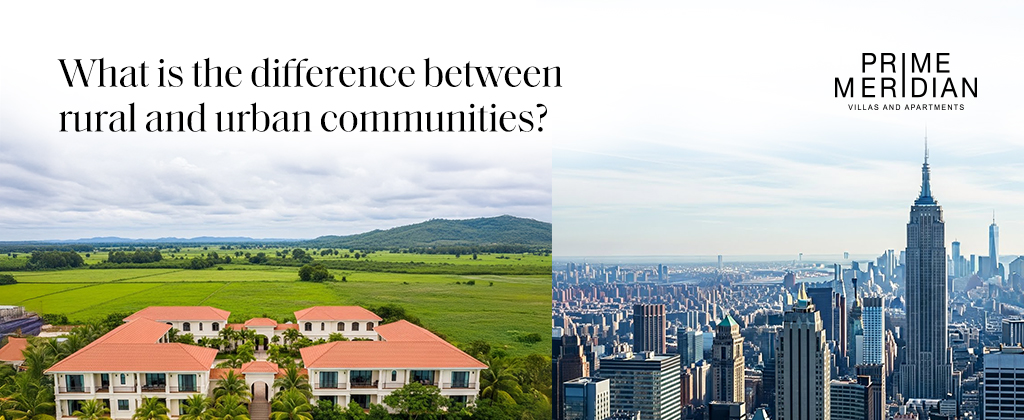
In our day-to-day talks about the communities, we use the words urban and rural without giving much thought to what they actually mean. But, it must be understood that the two terms have a few specific factors related to it.
The classification is based on a wide range of factors. Understanding the difference between the two is crucial. In this blog, we will make an attempt at a clear understanding of the difference between rural and urban communities.
What is meant by rural community?
A rural community refers to a human settlement based outside cities and towns. The primary characteristic that differentiates a rural community from an urban community is the low population density and a strong connection to agriculture and natural resources.
As per the definition by the planning commission, a rural community is a region that has a total population below 15000. Typically, rural areas include villages, hamlets, and small settlements with open spaces and natural vegetation. Even the population density is quite sparse, and homes are located quite far away from one another.
The rural settlement pattern allows the residents to have a close connection with the nature around them. In fact, nature and agriculture are the very foundation for a rural community.
Key features of a rural community
The key features of a rural community can be summed up as here below –
- Economic activities
Agriculture and animal husbandry form the prime basis of the rural economy. Farming, dairy production, and other related agricultural activities are the primary sources of income. You would find nature-inspired activities like cottage industries, traditional crafts, and small-scale businesses. Even the economic structure is quite simple.
- Governance and administration
The administration of the rural community is handled by the Gram Panchayats. These local self-governance bodies monitor administrative functions and implement development programs at the grassroots level.
- Family structure
Rural family structure follows a joint family. A large number of family members across multiple generations live under one roof. The family head, usually the male, holds authority over the decisions in the family. The patriarchal structure focuses on family solidarity, collective decision-making, and adherence to traditional customs.
- Cultural and social values
The rural society plays a major role and a strong emphasis on tradition, customs, and religious beliefs. There are strict moral codes and established societal norms. The strong sense of mutual aid is another plus point you would notice in a rural community.
What is meant by Urban community?
The urban community includes cities, towns, and suburban areas characterized by high population density. The urban regions also include concentrated infrastructure development, and diverse economic activities beyond agriculture.
Typically, urban areas are defined by how they are closely settled. They also come with significant development of commercial, industrial, and service sectors.
Key characteristics of an urban community
As with the rural community, here are a few specific characteristics of the urban community.
- Population and settlement
Urban areas have a strong sense of population density. The available lands are used for commercial buildings, residential complexes, roads, and public facilities. The green spaces are quite limited. There is a concentration of construction and infrastructure.
- Economic activities
The urban economy focuses on manufacturing, trade, commerce, services, finance, technology, and government. There are varied industries and employment activities in areas such as skilled workers, professionals, semi-skilled workers, technicians, artists, bankers, teachers, and social reformers.
- Infrastructure and development
Urban areas have well-developed infrastructure such as airports, ports, railways, highways, housing complexes, water supply systems, and electricity networks. These systems are designed to support the dense population.
- Population composition
Urban areas attract migrants from rural and other areas. This can create a diverse population with varied cultural backgrounds, religions, and social perspectives.
- Family structure
The urban families typically follow a nuclear family structure. Even when there is a joint family, it tends to be really small. Both men and women often pursue higher education and career opportunities. Decision-making is more democratic, with less control exerted by family elders over individual members.
- Social dynamics
The social dynamics follows an impersonal relationship and faster pace of life. Social interactions are governed by law and formal institutions rather than customary norms. However, social cohesion may be weaker, with residents often prioritizing individual interests over community welfare.
Key Differences Between Rural and Urban Society
The table below should give you a clear understanding of the difference between rural and urban society.
The detailed analysis of the difference between urban and rural community
| Aspect | Rural Community | Urban Community |
| Definition | Villages and settlements outside city boundaries | Cities, towns, and suburban areas |
| Population Density | Low population density; sparse distribution | High population density; concentrated settlement |
| Population Percentage (India) | More than 65% of India’s population | Approximately 34% of India’s population |
| Infrastructure Development | Limited infrastructure; underdeveloped utilities | Well-developed infrastructure; modern amenities |
| Primary Occupation | Agriculture, animal husbandry | Manufacturing, commerce, services, trade |
| Land Availability | Abundant vacant and undeveloped land | Land scarcity; most land developed |
| Economic Diversity | Limited economic activities; low specialization | Diverse economic sectors; high specialization |
| Family Structure | Large joint families; collective decision-making | Nuclear families; independent decision-making |
| Education Quality | Basic educational facilities; limited options | Advanced education system; numerous institutions |
| Healthcare Services | Basic medical facilities; limited specialists | Modern hospitals, advanced medical technology |
| Housing | Simple structures, mud, thatch, temporary materials | Modern buildings. cement, steel, advanced materials |
| Pollution Levels | Low pollution; cleaner environment | High pollution; vehicles and industries |
| Greenery | Abundant natural vegetation and green spaces | Limited green spaces; concrete-dominated landscape |
| Social Bonds | Strong community ties; mutual support | Weaker community bonds; individualistic approach |
| Cultural Values | Traditional, strict moral codes | Modern; tolerant of diverse perspectives |
| Pace of Life | Slower, leisurely pace; seasonal rhythms | Faster pace; rapid changes and adaptation |
| Governance | Panchayat Raj (village councils) | Municipal corporations and city administration |
The difference between rural society and urban society extends beyond just basic statistics. Rural communities focus on maintaining strong interpersonal relationships built over generations. These societies participate in a shared cultural practice.
In contrast, urban communities consist of strangers living in proximity, with relationships often remaining transactional and formal.
There is also a fundamental differences in terms of economic structure. Rural communities focus on agriculture and related activities. They can have serious consequences and vulnerability due to weather patterns. Urban economies offer protection to economy in the form of diversification. Multiple industries and job sectors mean economic disruption in one area doesn’t cripple the entire community.
There are also educational differences among the rural and urban communities. Rural children often have limited access to quality education. Urban children benefit from competitive educational systems that prepare them for specialized careers.
Environmental quality should be yet another significant difference. Rural areas are known to have a cleaner air and water due to limited industrial activity and lower population density. The natural ecosystem remains intact in these regions. Urban areas face persistent environmental challenges including air pollution from vehicles and industries, water contamination from industrial waste, and noise pollution affecting quality of life.
Conclusion
The difference between the urban and rural communities is significant and quite multifaceted. It spans multiple factors such as economic structures, social organizations, infrastructure development, cultural values, and lifestyle patterns.
It may also be noted that the differences between rural society and urban society are not rigid and permanent. The factors like urbanisation and industrialisation are actually erasing the differene between the urban and rural societies.
However, for a more streamlined development, both urban and rural areas should get a balanced treatment. Rural development through improved education, healthcare, agricultural innovation, and infrastructure is crucial for creating economic opportunities. Urban development must prioritize sustainable growth and quality of life.
The role of builders and developers is quite essential in this goal. Builders like Prime Meridian focus in playing a major role in this context.