



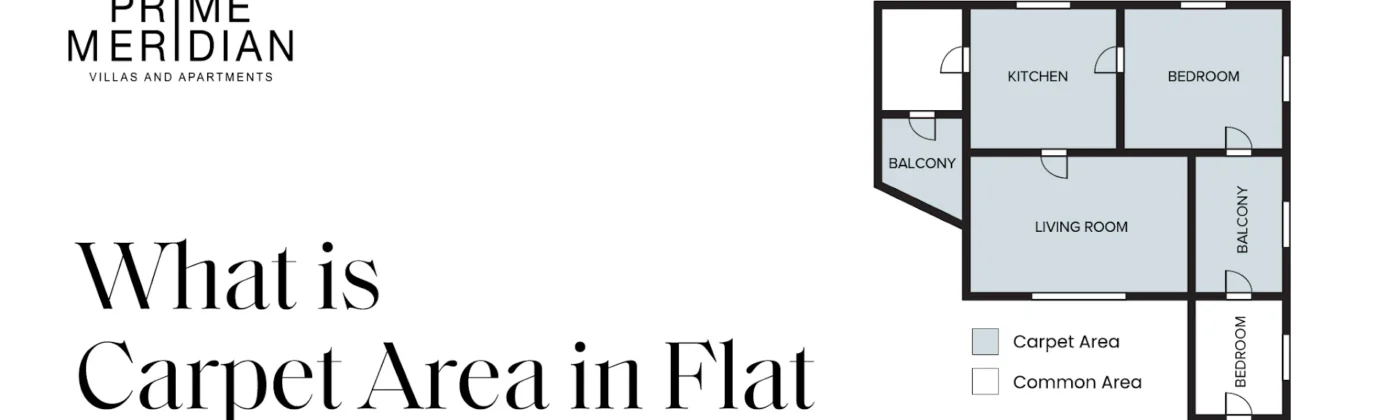
Buying a new home is a very significant decision. But when browsing through different flats and other residential areas, you are most likely to get confused about the technical jargon used in the specifications.
One such jargon used in real estate transactions is Carpet Area. In fact, carpet area, along with other terms like built-up area and super built-up area, can indeed be really difficult to understand. We at Prime Meridan believe in educating potential customers, which is exactly why we decided to explain the term “carpet area” for newbie customers.
What is the carpet area in flat?
A carpet area literally means the area in the flat that you can spread a carpet across. In other words, it is the actual space area within the four walls. If you have multiple rooms, you will need to calculate the usable area of each room and then add them together.
According to the Real Estate (Regulation and Development) Act (RERA), carpet area is defined as the net usable floor area of an apartment. It excludes the area covered by the walls, areas that fall under the service shafts, any exclusive balcony or verandah, and exclusive open terrace area.
| As per Section 2(k) of the RERA Act, 2016, the carpet area is defined as
“The net usable floor area of an apartment, excluding the area covered by the external walls, areas under services shafts, exclusive balcony or verandah area and exclusive open terrace area, but includes the area covered by the internal partition walls of the apartment”. |
What does carpet area include?
- All rooms (Living room, Bedrooms, Dining room)
- Kitchen and Bathrooms
- Internal partition walls
- Store rooms or internal cupboards
It does not include
- External walls
- Balconies and terraces
- Verandahs
- Common areas (lifts, stairs, lobby)
It may be noted that there is a difference between the traditionally measured carpet area and RERA approved carpet area. The traditional carpet area excludes the internal walls between the different rooms. It considers the actual area you can walk on or carpet. However, RERA approved definition of carpet area takes internal walls into account.
How to Calculate Floor Carpet Area for a Flat?
You may wonder why you need to calculate the carpet area. In fact, the carpet area is the essential measure of what you are being charged for. In most of the cases, developers focus on the super built-up area. However, the actual usable area or the area of the flat that you actually own is the one that corresponds to the carpet area.
To calculate the carpet area of your flat, sum the areas of all the rooms and internal spaces.
Carpet Area Calculation Formula
Carpet Area = (Area of Living Room + Bedrooms + Kitchen + Bathrooms + Internal Walls) – (Thickness of External Walls)
For instance, imagine you are looking at a 2BHK flat with the following dimensions:
- Living Room: 15 ft x 10 ft = 150 sq. ft.
- Main Bedroom: 12 ft x 10 ft = 120 sq. ft.
- Guest Bedroom: 10 ft x 10 ft = 100 sq. ft.
- Kitchen: 8 ft x 7 ft = 56 sq. ft.
- Two Bathrooms: 5 ft x 8 ft each = 80 sq. ft.
- Internal Walls: Approximately 30 sq. ft.
Total Carpet Area: 150 + 120 + 100 + 56 + 80 + 30 = 536 sq. ft.
What is Built-Up Area?
Built-up area corresponds to the sum of the carpet area and the space covered by the thickness of the external walls and the balcony. In many cases, the built-up area is 10 to 15% larger than the carpet area.
How to Calculate Built-Up Area
Built-Up Area = Carpet Area + Area of External Walls + Area of Balcony & Terrace
Example:
Using the previous example where the carpet area was 536 sq. ft.:
External Walls: 50 sq. ft.
Balcony: 60 sq. ft.
Total Built-Up Area: 536 + 50 + 60 = 646 sq. ft.
What is Super Built-Up Area?
The Super Built Up area is the saleable area that developers typically use to market their flats. It includes the built-up area plus a proportionate share of the residential project’s common amenities.
The common amenities in the super built-up area include the lobby, lift shafts, stairs, swimming pool, clubhouse, and security ducts.
How to Calculate Super Built-Up Area
Super Built-Up Area = Built-Up Area + Proportionate share of common areas
(Note: Developers often use a “Loading Factor,” which typically ranges from 25% to 40% of the carpet area.)
Example:
If the Built-Up Area is 646 sq. ft. and the developer applies a loading factor of 30% on the carpet area for common amenities:
Super Built-Up Area: 646 + (536 x 0.30) = 806.8 sq. ft.
The loading factor used to calculate the super built-up area varies by region and location.
The typical loading factors can be found from the following table –
| City (2026 Averages) | Typical Loading Factor | Efficiency (Usable Space) |
| Mumbai (MMR) | 40% – 50% | ~55% Usable |
| Bangalore / Hyderabad | 25% – 35% | ~70% Usable |
| Chennai | 20% – 30% | ~75% Usable |
| Delhi-NCR | 30% – 40% | ~65% Usable |
Tip – For the exact loading factor in your area, consult your developer or real estate agent.
Key Differences at a Glance between carpet area, built-up area, and super built-up area
The table below should give you a clear idea of how the carpet area, built-up area, and super built-up area differ.
| Feature | Carpet Area | Built-Up Area | Super Built-Up Area |
| Meaning | Actual usable area inside walls. | Carpet area + walls + balconies. | Built-up area + common facilities. |
| RERA Mandatory | Yes, the price must be quoted on this. | No | No |
| Inclusions | Rooms, internal walls, toilets. | Carpet area + outer walls + balcony. | Built-up area + lobby, lifts, pool. |
| Space Efficiency | High (Actual space you use). | Medium | Low (Includes shared spaces). |
Key factors that you should consider when buying your flat
Well, even when you are aware of how carpet area, built-up area, and super built-up area affect the overall value of your flat, there are a few key factors that would make a huge difference in your buying decisions.
- Check the RERA Carpet Area: Always ask for it. By law, developers must disclose this figure to prevent misleading buyers with inflated “Super Built-Up” numbers.
- Understand the Loading Factor: If there is a massive gap between the carpet area and the super built-up area (e.g., more than 35%), the loading factor is high. Ensure the amenities provided justify this extra cost.
- Physical Measurement: During site visits, carry a tape measure or ask for a detailed floor plan with dimensions to verify that the promised carpet area matches the on-site reality.
- Furniture Planning: Always plan your furniture layout based on the carpet area, not the super built-up area, to avoid overcrowding your rooms.
Financial implications of the carpet area, built-up area, and superbuilt-up area.
The type of measurement can affect how your budget or taxes can be impacted.
- Property Tax: Most Municipal Corporations (such as PMC or BMC) now use the Capital Value System or Unit Area System, based on the built-up or carpet area.
- Maintenance Charges: You may need to check your society’s bylaws. Some societies charge based on the Super Built-Up area. However, the newer 2026 guidelines encourage charging based on the RERA Carpet Area for fairness.
- Home Loans: Banks generally conduct their own independent valuations. If there is a significant discrepancy between the developer’s area and the bank’s measurement, your loan-to-value (LTV) ratio might be lower than expected.
Conclusion
When buying a flat, it is highly important to give serious thought to the carpet area. That would help you understand what you are paying for. Of course, the super built-up area determines the type and details of the amenities you get as part of the deal. But the carpet area is what would help you determine the actual comfort level of your daily life.
Before signing on the dotted line in 2026, ensure your sale agreement clearly states the RERA Carpet Area to protect your investment and ensure full transparency.
Are you looking for a home that maximizes space and efficiency? Explore our latest projects at Prime Meridian, where transparency meets luxury.
FAQs
Are balconies and terraces included in the RERA Carpet Area?
No. RERA explicitly excludes “exclusive balcony or verandah area” and “exclusive open terrace area” from the definition of carpet area. These are accounted for in the Built-Up Area. If a developer includes the balcony in the “Carpet Area” figure, they are violating RERA disclosure norms. Always ask for the breakdown.
Is the price of a parking space included in the Carpet Area?
No. Parking spaces (whether open, stilt, or basement) are considered “Common Areas” or “Independent Units” depending on local state RERA rules. In your allotment letter, the parking space must be mentioned as a separate entity with its own specific dimensions. It should be distinct from the apartment’s square footage.
What happens if a developer markets a “Usable Area” instead of “Carpet Area”?
“Usable Area” is an unofficial term often used by sales teams to refer to the combined Carpet Area and Balcony Area, making the flat seem larger.